Building Trust
Every handoff, every hard conversation and every bit of growth runs on trust.
Trust is the skill behind every other skill
You can learn to delegate, coach and give feedback. But none of it works if people don’t trust you, and you can’t grow people you won’t trust.
That’s why trust comes first. If you want to grow as a leader, at work or in your own life, you have to master trust and how to build it.
When trust is high, people move mountains. They take on stretch work, speak up early and give their best without being asked. When it’s low, even simple things stall.
The research points the same way. Researchers Kurt Dirks and Donald Ferrin combined 106 samples in a review of trust in leadership and found that trust in a direct leader, like a supervisor, stood out as especially important. For the people who count on you, that leader is you.
So trust isn’t a soft extra. It’s how you build strong teams and relationships that last. It’s built in four steps: trust yourself, extend it, earn it and honor it.
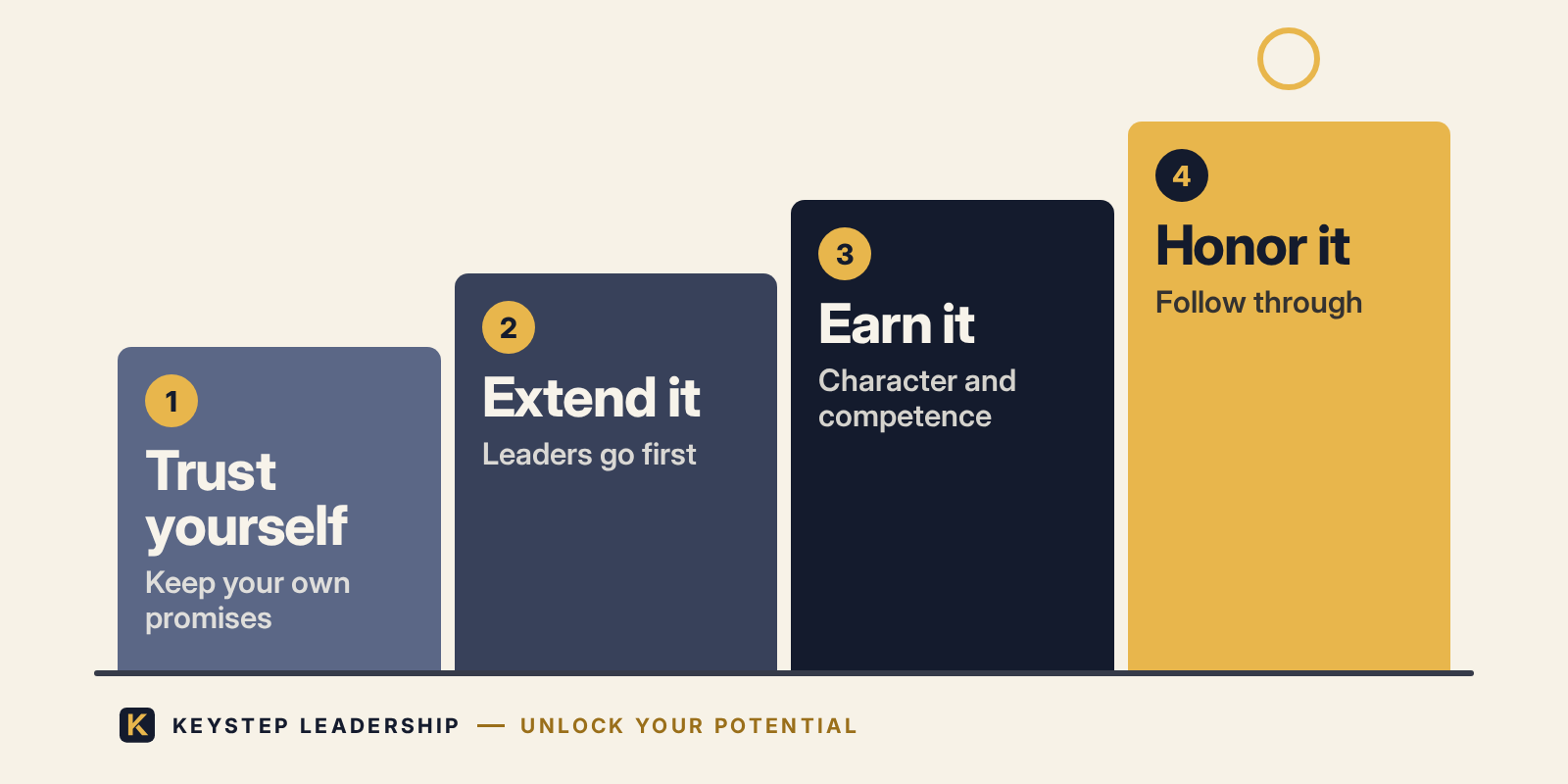
It starts with trusting yourself
It’s hard to give trust, or be counted on, when you aren’t sure you can count on yourself.
Psychologist Albert Bandura called that belief self-efficacy: your confidence that you can handle what’s in front of you. His research linked it to how much effort people put in and how long they keep going when things get hard. He also found that the strongest way to build it is through real experiences of success, not pep talks.
That’s good news, because you can create those experiences on purpose. Start with the promises you make to yourself. Make one small one each day, and keep it. Each kept promise is proof that you’re someone you can rely on.
Watch the story you tell yourself, too. “I’m not a leader” and “They won’t listen to me” are beliefs, not facts. Notice them, choose a better one, and act from it again and again. That’s the ABCs at work: Awareness, Belief and Commitment. For the full breakdown, read The ABCs of Leadership.
Extend trust first
Most people wait to be trusted before they trust anyone else. Leaders go first.
Extending trust is how you earn theirs. When you hand someone real responsibility, you’re telling them you believe in them, and most people rise to meet that.
Psychologist Julian Rotter, reviewing a series of studies, found that people who trust more aren’t more gullible than people who trust less. They’re more likely to give others a second chance, and they’re liked more and sought out as friends more often. Trusting well isn’t naive. It’s a strength.
Hand over real decisions, with clear limits. Don’t just hand off tasks. Give someone a decision that matters, say what’s theirs and what isn’t, and explain why you trust them with it.
Coach the miss, don’t take it back. The first try won’t be perfect. If you grab the work back, you teach them to wait for you. Ask what they learned, help them adjust, and hand it back.
Picture a leader who checked every report before it went out. One week, she tells a teammate, “This one’s yours. Send it when you’re happy with it.” The report goes out a day early, and the teammate starts bringing ideas she’d never shared before. Nothing about the work changed. The trust did.
This works at home, too. Let a friend, partner or teenager own something real, and watch what grows.

Earn it, then honor it
Extending trust opens the door. Earning it and honoring it keep it open.
Earn it with character and competence. Researchers Roger Mayer, James Davis and David Schoorman identified three qualities at the core of being trusted: ability, benevolence and integrity. Put simply, people trust you when you’re good at what you do, when they believe you want good things for them, and when you tell the truth. Stephen M. R. Covey sums it up as character plus competence.
So when you take something on, see it through with excellence. Then get a little better each time. Every round you deliver, and improve, is proof people can count on you.
Honor it by following through. Keep the promises you make to others, and keep the ones you make to yourself. Close the loop, even when the answer is no. Keep what’s shared with you in confidence. That’s how trust becomes a lasting bond.
When you miss, own it fast. Researchers Peter Kim, Donald Ferrin, Cecily Cooper and Kurt Dirks found that for honest mistakes of skill or judgment, an apology repaired trust better than a denial. “That was on me, and here’s how I’ll make it right” goes a long way.
Trust also grows when people know what they own and have what they need to do it well. That’s the work of The Systems That Build Strong Teams: simple systems that set clear expectations, give people what they need and keep them growing.

Take the Keystep
The keystep is the most important step you can take, because it’s the next one.
So where do you stand? The Trust Check is a quick, honest look at all four steps. Rate 16 short statements, and you’ll see four scores: how much you trust yourself, how freely you extend trust, how well you earn it and how faithfully you honor it.
It takes about five minutes, and it works whether you lead a team or simply want stronger relationships at work and at home. Your lowest score is your keystep.
When you finish, you can get the free Trust Builder guide. It explains what each score says about you, and gives you simple, research-backed ways to grow each kind of trust.
Take the Trust Check, and find your next step.
Unlock your potential. Become a Keystep leader.
Get the next keystep in your inbox
New articles and practical tools for new leaders, plus first access when tools launch.
No spam. Unsubscribe anytime. See the privacy policy.
Keep going
- The Shift From Doer to Leader, for why your product is now doers.
- Managing Versus Leading, for why growing people is the leading half of the job.
- What It Means to Be a Leader, for the three levels of leadership and where trust fits.
- The Systems That Build Strong Teams, for the tools that make every handoff clear.
Sources
- Kurt T. Dirks and Donald L. Ferrin, “Trust in Leadership: Meta-Analytic Findings and Implications for Research and Practice,” Journal of Applied Psychology, on 106 samples and direct leaders as an especially important focus of trust (paraphrased).
- Albert Bandura, “Self-Efficacy: Toward a Unifying Theory of Behavioral Change,” Psychological Review, on self-efficacy and mastery experiences (paraphrased).
- Julian B. Rotter, “Interpersonal Trust, Trustworthiness, and Gullibility,” American Psychologist, on high trusters not being more gullible (paraphrased).
- Roger C. Mayer, James H. Davis and F. David Schoorman, “An Integrative Model of Organizational Trust,” Academy of Management Review, on ability, benevolence and integrity (paraphrased).
- Stephen M. R. Covey, The Speed of Trust, on trust as character plus competence (paraphrased).
- Peter H. Kim, Donald L. Ferrin, Cecily D. Cooper and Kurt T. Dirks, “Removing the Shadow of Suspicion,” Journal of Applied Psychology, on apology versus denial in repairing trust (paraphrased).