Managing Versus Leading
They’re not the same job. You need both, and only one of them outlasts you.

The myth
Most people step into leadership the same way. You were good at the work, so now you’re in charge of the people doing it, and everyone assumes you’re a leader.
That’s the myth: managing and leading are the same job with two names.
They aren’t. You can run a tight schedule, hit every deadline, and still not be leading anyone. You can also inspire a room and leave the work undone. Both jobs matter, and neither one is the lesser job. They just do different things. John Kotter put it this way in Harvard Business Review: management copes with complexity, leadership copes with change, and an organization needs both.
Managing versus leading
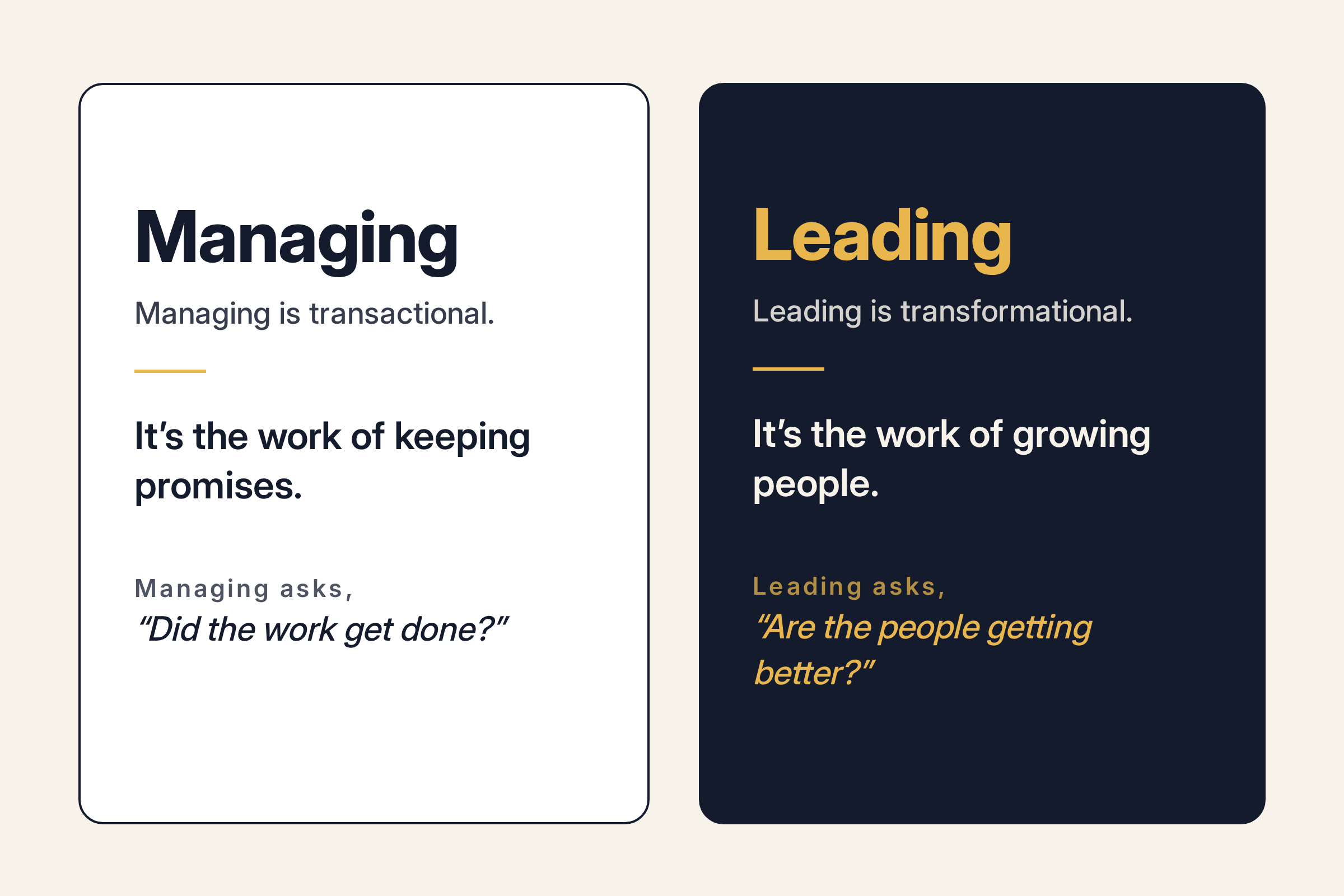
Managing is transactional. It’s the work of keeping promises. Who’s here today. What’s due, and when. Who did what, and whether it met the standard. Work goes in, results come out, and the manager makes sure that exchange holds up. This isn’t small work. A team without it is chaos with good intentions.
Leading is transformational. It’s the work of growing people. It’s trust, earned over time. It’s developing someone until they can do what they couldn’t do last year. It’s getting people across teams to pull together toward a goal nobody could reach alone. The historian James MacGregor Burns first drew this line, describing leadership that raises leaders and followers to a higher level of purpose.
Managing asks, “Did the work get done?” Leading asks, “Are the people getting better?”
The price of only doing one
Picture two teams.
The first is only managed. Every task is tracked. Every deadline is met. For a while, it looks great. But nobody knows why the work matters, and nobody’s growing. People do exactly what’s asked and nothing more. Then they stop caring. Then they burn out, or they leave.
The second is only led. The vision is inspiring, and people believe in it. But nobody owns the schedule, and nothing gets followed through. Big ideas stall. Deadlines slip. Before long, the inspiration turns into frustration.
One team has follow-through without heart. The other has heart without follow-through. Neither one lasts.
The leader worth following
The best leaders do both. They run the operation well, and they build the people who run it.
Not every manager is a leader. A title gives you authority. It doesn’t give you followers.
Here’s the good news: both are skills. With the right training and tools, anyone can learn to manage. Nobody’s born knowing how to build trust or develop people, and anyone willing to do the work can learn to lead.
A leader is someone people want to follow. Not because they have to, but because following them makes their world better and pushes them toward greatness. The best leaders are fire starters. They light the next leader, who lights the one after that. It becomes a flywheel of positive impact that keeps turning long after the first leader is gone.
Every leader also casts a shadow. It’s how people work, think, and treat each other because of you, even when you’re not in the room. That shadow is the real measure. Not the title. Not one quarter’s numbers. Yours is being cast right now. The only question is what it will look like.

Why Keystep Leadership exists
Our mission is simple: to give individuals the training, tools and resources they need to unlock their potential and become leaders who leave a legacy of lasting, positive impact.
You can’t build that legacy by managing alone. Managing keeps today’s work on track. Leading is what lasts, because it lives on in the people you built.
That journey runs on three pillars:
- Self-Mastery: leading yourself first, because you can’t give others what you haven’t built in yourself.
- Managing: the operational pillar, where you build and run the operation.
- Leading: the relational pillar, where you communicate, work with others, and grow your people.
A Keystep leader builds all three. Master yourself, run the operation, grow the people. Skip one, and the other two start to wobble.
Manage well. Then go further.
Unlock your potential. Become a Keystep leader.
Take the Keystep
The keystep is the most important step you can take, because it’s the next one.
Take a sheet of paper and draw a line down the middle. Label the left side “Managing” and the right side “Leading.”
Think back over your last week and write down where your time actually went. Schedules, deadlines and tracking go on the left. Coaching, building trust and helping someone grow go on the right.
Circle the thinner side. Then write down one thing you’ll do this week to build it.
Then use the ABCs to make the change stick. Become aware of where your time really goes, believe the thinner side matters as much as the other, and commit to building it, one week at a time. New to the ABCs? Start with The ABCs of Leadership.
Get the next keystep in your inbox
New articles and practical tools for new leaders, plus first access when tools launch.
No spam. Unsubscribe anytime. See the privacy policy.
Keep going
- What It Means to Be a Leader, for the one test that tells you whether you’re leading.
- The Shift From Doer to Leader, for letting go of the work you used to do yourself.
- Building Trust, for the foundation every part of leading stands on.
Sources
- John P. Kotter, “What Leaders Really Do,” Harvard Business Review, on management and leadership as distinct, complementary jobs (paraphrased, not quoted).
- James MacGregor Burns, Leadership (Harper & Row), which introduced the contrast between transactional and transforming leadership (paraphrased, not quoted).
- Bernard M. Bass, Leadership and Performance Beyond Expectations (Free Press), which developed transformational leadership for organizations (paraphrased, not quoted).