What It Means to Be a Leader
A title doesn’t decide whether you’re a leader. The people who grow because of you do.
Leadership isn’t a title
You’re already leading. Someone is watching how you handle a hard moment, whether it’s a teammate, your kids, a friend or the person in the mirror.
Most people think leadership starts with a title: a promotion, a team, a name on a chart. That’s the boss part. It comes with authority, and authority can get things done. Leadership starts somewhere else, and it has to be earned, one person at a time.
Here’s a plain definition. A leader moves people toward something better, and leaves them better than they found them.
By that definition, everyone leads something. A team, a family, a project, or simply their own life. Researchers James Kouzes and Barry Posner, who built their model by studying leaders at their personal best, describe leadership as everyone’s business and as a skill that can be learned, not a position you’re handed.
Running the work well is part of the job too, and Managing Versus Leading covers that side. This article is about the part that makes you a leader.
The test that matters
So how do you know if you’re leading well? Robert Greenleaf, who coined the term servant leadership, offered what he called the best test: “Do those served grow as persons?” He asked whether people become healthier, wiser, freer and more able to stand on their own, and whether they become more likely to serve others themselves.
That test has held up. Researcher Robert Liden and colleagues built a measure of servant leadership that includes helping people grow and succeed. They found it explained people’s job performance, commitment and willingness to help their community, beyond what other well-known leadership measures explained.
Notice what the test isn’t. It isn’t popularity. It isn’t being the hardest worker in the room. It isn’t having every answer, or how many people report to you.
It’s one question. Are the people around you growing because of you?
A title makes you the boss. People make you a leader.

The three levels of leadership
Leadership grows through three levels: lead yourself, lead others and grow leaders. Each level builds on the one before. You don’t have to master one before you start the next, but each one makes the next one possible.
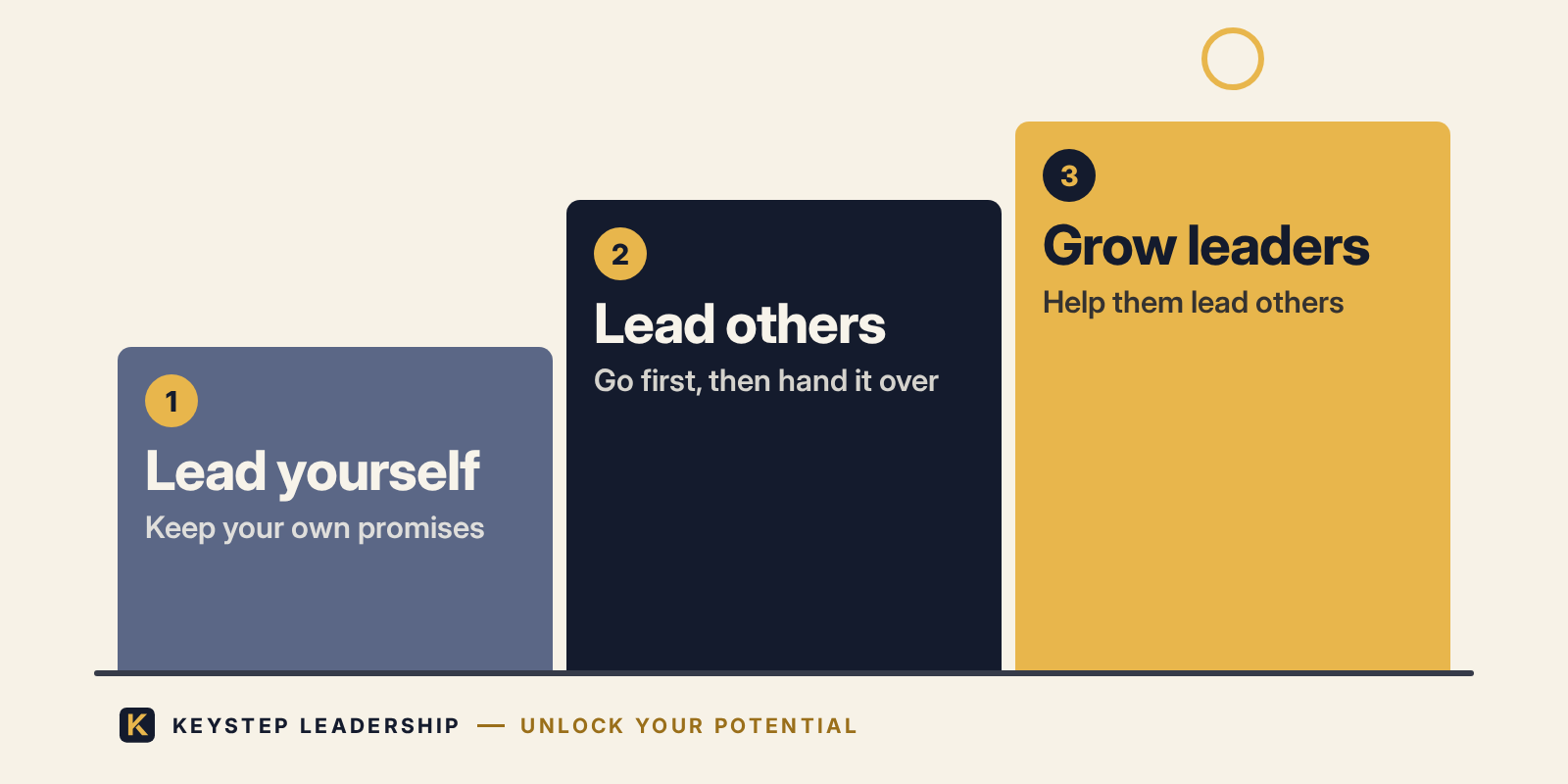
Level 1: Lead yourself. Researcher Charles Manz called this self-leadership: the way you guide your own thinking, motivation and actions. It’s keeping the promises you make to yourself, setting your own goals and owning your part when something goes wrong. In a later review of the research, Greg Stewart, Stephen Courtright and Manz found that people with more self-leadership consistently showed better attitudes and better work performance. It’s also where trust begins, as Building Trust explains.
Level 2: Lead others. Once you can lead yourself, you can help others move. Two of Kouzes and Posner’s five practices fit this level best. Model the Way means you go first and set the example. Enable Others to Act means you build trust and strengthen people by giving them real choices and helping them build skill. At work, that’s handing someone a real decision. At home, it’s letting your kid own a choice and live with how it turns out.
Level 3: Grow leaders. This is the highest level. You’re not just helping people do well. You’re helping them lead themselves, and then lead others. Manz and Henry Sims called this SuperLeadership: leading others to lead themselves. It’s the last part of Greenleaf’s test, too. The people you serve start serving others. That’s how your impact outlasts you, and why, as The Shift From Doer to Leader puts it, your product becomes doers.
What changes when you lead this way
When you take the test seriously, three things change.
Your questions change. You stop asking “What did I get done?” and start asking “Who got better today?”
Your calendar changes. Time with people goes in first: coaching, one-on-ones, real conversations at home. The rest fits around it.
Your wins change. Someone solving a problem without you becomes the win, even when you’d have solved it faster.
Picture a leader who always had the answer. People brought problems, and the leader solved them, fast and well. Then the leader started answering questions with one of their own: “What would you do?” At first it felt slower. It took patience, and some answers came back wrong before they came back right. A few months later, people were bringing solutions instead of problems. And one of them was ready to lead.
Nothing about the work changed. The leader did.

Changing a habit like that takes more than knowing better. Notice the old pattern, believe a new one, and commit to choosing it again and again. That’s the ABCs at work: Awareness, Belief and Commitment. For the full breakdown, read The ABCs of Leadership.
Take the Keystep
Every leader is working on one of the three levels of leadership right now, whether they know it or not. Maybe you keep your own promises but rarely hand off real decisions. Maybe your team trusts you, but nobody’s ready to step up when you’re gone. The level that holds you back is your keystep: the one place where a small move makes the biggest difference.
The Find Your Leadership Level quiz shows you which level that is. Rate 15 short statements, and you’ll get a score for leading yourself, leading others and growing leaders, along with your strongest level and your keystep.
It takes about five minutes, and it works whether you lead a team, a family or just yourself right now.
When you finish, you can get the free Leader Builder guide. It explains what each score says about you, and gives you simple, research-backed ways to grow at each level.
Find your leadership level, and take your next step up.
And when you’re ready to grow the people around you, The Systems That Build Strong Teams gives you simple systems that set clear expectations, give people what they need and keep them growing.
Unlock your potential. Become a Keystep leader.
Get the next keystep in your inbox
New articles and practical tools for new leaders, plus first access when tools launch.
No spam. Unsubscribe anytime. See the privacy policy.
Keep going
- Building Trust, for the skill behind every other skill.
- The Shift From Doer to Leader, for why your product is now doers.
- Managing Versus Leading, for why running the work and growing the people are two different jobs.
Sources
- Robert K. Greenleaf, Servant Leadership, on the best test of leadership: whether those served grow as persons (quoted and paraphrased).
- Robert C. Liden, Sandy J. Wayne, Hao Zhao and David Henderson, “Servant Leadership: Development of a Multidimensional Measure and Multi-Level Assessment,” The Leadership Quarterly, on servant leadership explaining performance, commitment and community citizenship beyond other leadership measures (paraphrased).
- James M. Kouzes and Barry Z. Posner, The Leadership Challenge, on leadership as learnable and everyone’s business, and on Model the Way and Enable Others to Act (paraphrased).
- Charles C. Manz, “Self-Leadership: Toward an Expanded Theory of Self-Influence Processes in Organizations,” Academy of Management Review, on self-leadership (paraphrased).
- Greg L. Stewart, Stephen H. Courtright and Charles C. Manz, “Self-Leadership: A Multilevel Review,” Journal of Management, on self-leadership and individual attitudes and performance (paraphrased).
- Charles C. Manz and Henry P. Sims Jr., The New SuperLeadership: Leading Others to Lead Themselves, on leading others to lead themselves (paraphrased).